
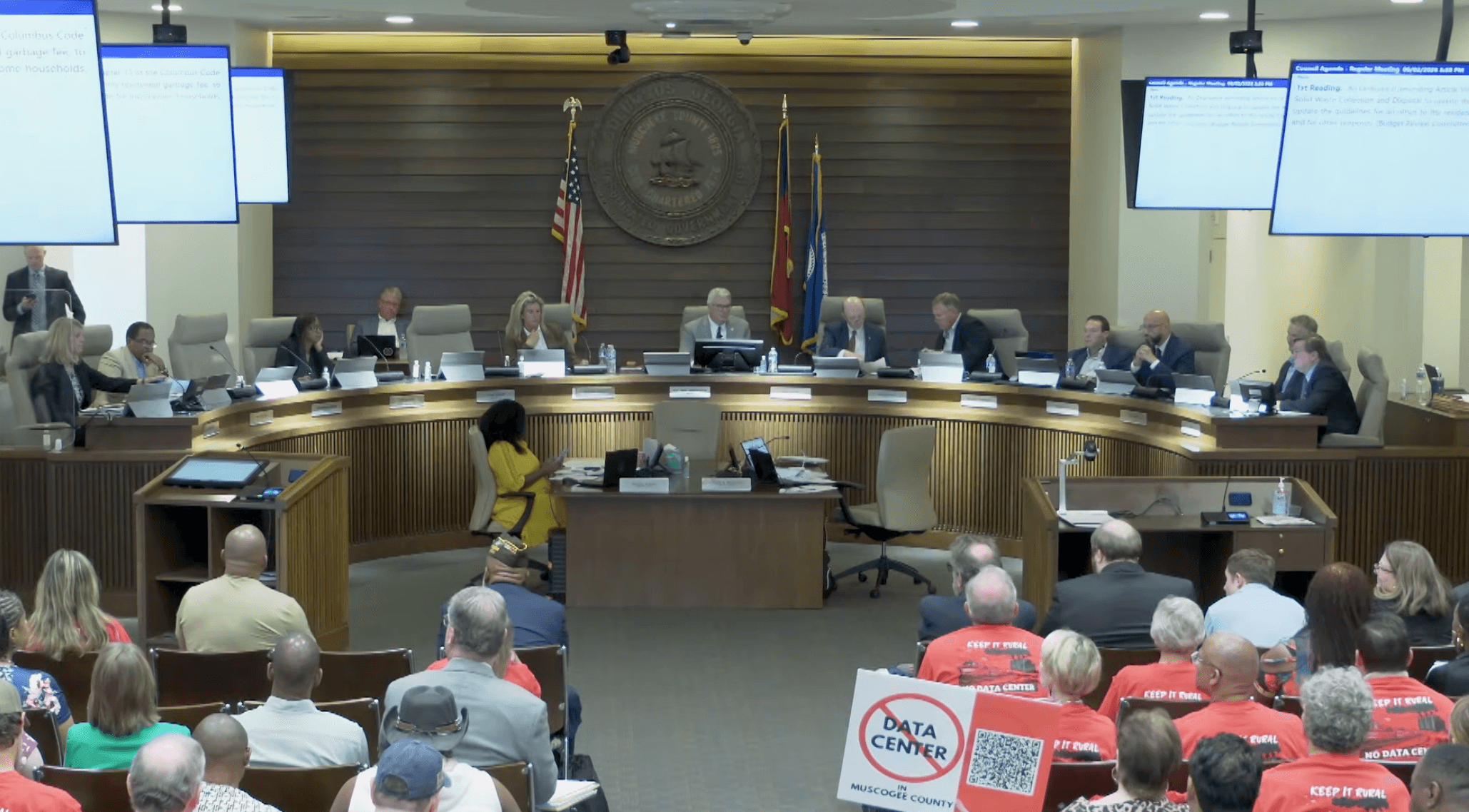
As the national backlash against hyperscalers grows, data center moratoriums have become a standard item on local government agendas. But with thousands of local governments and no centralized reporting system, tracking how moratoriums move is nearly impossible without real-time data. GatherGov tracks local government meetings, agendas, and minutes from more than 9,000 cities and counties — coverage deep enough to watch a moratorium travel from an offhand comment to a hardened ordinance.
Since January 2026, we've found moratorium-related activity in public meetings across 1,030 U.S. jurisdictions. In 632 of them, the conversation has turned into concrete action to pause data center approvals — a formal ordinance introduction by a councilmember, a staff study, an adopted ordinance, or an extension of a moratorium already on the books.
And the number keeps climbing. Mentions of "data center moratorium" in city and county meetings rose every month through August 2026, with no sign of a peak. They were nearly nonexistent in mid-2025, crossed 100 per month in early 2026, and topped 800 monthly mentions by summer. County-level meetings — where most unincorporated land sits — account for a fast-growing share.
 Monthly mentions of "data center moratorium" in public meetings, by government level. Source: GatherGov.
# Breakdown of Data Center Moratorium Activity
Based on GatherGov's meeting-level data, the cities and counties discussing moratoriums from January through early September 2026 break down like so:
- 270 jurisdictions have adopted a data center moratorium
- 25 have extended one already in place
- 120 have formally introduced an ordinance or held a first reading
- 232 have directed staff studies or legal review — a step that usually precedes an ordinance
- 172 more are fielding public requests for a moratorium that haven't yet converted into council action
The geography is broad. Georgia leads with 45 jurisdictions in a formal process, followed by North Carolina (39), Florida (37), Wisconsin (36), and New Jersey (33). California, Massachusetts, and Michigan each have 20 or more.
 Formal moratorium activity across 632 U.S. jurisdictions since January 2026. Source: GatherGov public meeting records.
Moratoriums also don't become law overnight. In most of the places we've studied, there's a pipeline that carries casual demand toward an ordinance — sometimes turning around in a matter of months. For this analysis, we classified moratorium discussions into the following stages using Anthropic's Claude Sonnet model:
- Requested by Public — residents demand action during comment periods; no council motion yet. 172 jurisdictions fall here.
- Proposed by Councilmember / Formally Introduced — an elected official formally puts a proposal on the table. 150 jurisdictions combined.
- Under Legal Review / Staff Study Directed — the council has told staff or counsel to start drafting. 232 jurisdictions sit at this stage, and in our data it converts to adoption more often than not.
- Adopted → Extended — the ordinance passes, and some later get renewed. 295 jurisdictions total have reached this stage.
# What Moratoriums Are For
On paper, a data center moratorium is a time-limited pause: the jurisdiction stops accepting or processing data center land use applications while it studies impacts and writes new regulations. Most are creatures of state enabling law — California's Government Code §65858, for example, lets cities adopt urgency moratoriums for 45 days and extend them up to roughly two years while new rules get drafted. The pause is supposed to have a purpose and an end date.
In practice, as public opposition to data centers hardens, a lot of what gets called a moratorium is starting to look like a permanent ban wearing a temporary label.
# Pause vs. Ban: The Three Types of Moratoriums Being Passed
Not all moratoriums are built the same. Across our dataset, we've identified three distinct types, with very different durations and endgames.
# The procedural pause to draft new laws
 The first kind of moratoriums are temporary pauses while new regulations are being passed. An example from Social Circle, GA which let its moratorium lapse once data center regulations passed
The first kind is exactly what the statute intends: a short suspension of applications while the jurisdiction writes its rulebook.
Commerce, California adopted a 45-day urgency moratorium. Morgan County, Georgia approved 120 days explicitly to give staff time to write an ordinance. Tuolumne County, California framed its moratorium as breathing room to work out fee and impact details. When these jurisdictions talk about the moratorium in meetings, the language is administrative — study sessions, ordinance drafts, sunset dates.
These pauses often end the way they're supposed to. Social Circle, Georgia let its moratorium lapse once data center regulations passed. Logan County, Colorado moved to adopt permanent facility regulations specifically so it could lift its moratorium. For a developer, a procedural pause is a delay — typically 6 to 18 months — not a dead end. The jurisdiction is telling you what its rules will be; the smart play is to engage during the drafting window.
# The codified timeout
The middle of the spectrum is the 12-month moratorium that behaves like a longer one. Denver adopted a one-year moratorium that other jurisdictions now cite as precedent. DeKalb County, Georgia extended its moratorium through March 2027, conditioned on a study review before it can be lifted. Clayton County pushed its countywide pause through the end of December 2026. Augusta extended by "not less than 90 days."
The tell is the Extended status. A pause that keeps getting renewed — especially when the stated study never quite concludes — is drifting toward prohibition. Twenty-five jurisdictions have already extended at least once in 2026, and extension items increasingly show up on consent agendas, which means they pass without debate.
# The hard stop
 Monterey Park, California, became the first U.S. city to ban data centers by public vote to make their moratorium harder to challenge in court.
At the far end, some jurisdictions have stopped pretending the pause is temporary. The clearest case is Monterey Park, California, which became the first U.S. city to ban data centers by public vote: in June 2026, residents approved Measure NDC with more than 88% support, permanently prohibiting data centers citywide — a ban only another public vote can undo.[1] The council deliberately routed the ban through the ballot box to make it harder to challenge in court than an ordinance passed by five councilmembers.[2]
San Marcos became the first Texas city to ban data centers outright, voting 4–3 in June to make them ineligible in every zoning district, citing water and energy strain.[3] Rio Grande County, Colorado passed a one-year moratorium and a separate outright ban on hyperscale facilities in the same action. And the ban conversation is spreading even where councils haven't acted: in Desert Hot Springs, Palm Springs, Tulare County, and Humboldt County, California — and in Pasco and Santa Rosa Counties in Florida — the public or the board itself is openly discussing converting a temporary moratorium into a permanent prohibition.
The hard stops carry real legal risk. Zoning powers are broad, but permanently telling property owners what they can never build lands squarely in legal gray territory. Courts generally tolerate moratoriums that are time-limited and tied to an active planning effort, and get skeptical when they look like indefinite prohibition dressed up as study.
Councils know the risk, and they're working different angles around it. Birmingham's staff briefed the council on the legal limits of outright bans. A Tyrone, Georgia councilmember noted the town can't ban data centers but can attach conditions. In Wakulla County, Florida, the discussion of a permanent ban centered on litigation exposure under state law.
 In Olive Branch, after a developer's lawsuit, the board immediately met and overturned their data center moratorium.
That risk is not hypothetical: Olive Branch, Mississippi passed a moratorium, got sued by a developer, and overturned it almost immediately; Hill County, Texas rescinded its moratorium after a developer sued for $100 million;[4] and Imperial County, California's one-year moratorium was reportedly invalidated by a court ruling. State preemption is tightening too — Texas legislators moved to limit city bans in industrial zones after San Marcos acted, and a state senator requested an attorney general opinion on whether counties can restrict data centers at all.[5]
# What's Driving the Hard-Stop Jurisdictions
Why do some places reach for a permanent ban while their neighbors settle for a study period? The meeting transcripts point to a consistent pattern: a live project forces the issue.
Monterey Park's ban grew directly out of a proposed conversion at 1977 Saturn Avenue, which drew months of organized opposition over diesel backup generators, noise, and utility costs before the developer withdrew.[6] In Fairbanks North Star Borough, Alaska, testimony supporting a moratorium referenced a federal land lease near residents' homes for an AI data center. Clay County, Florida's planning commission confirmed on the record that pending applications cannot be approved while its moratorium stands — the moratorium exists precisely because applications exist.
The escalation logic is simple: a jurisdiction with a specific project on its doorstep hears specific grievances — this water table, this substation, this neighborhood's noise floor — and residents conclude that regulation-writing won't be finished before the project is. A permanent ban becomes the only tool that feels fast enough.
Jurisdictions acting preemptively behave differently. Escondido, California's council explicitly framed its 45-day moratorium as proactive, noting there were no pending applications. San Marcos passed its ban with no data center proposed inside city limits — but with at least two proposed just across its border in unincorporated Hays County, close enough to feel imminent.[7] Preemptive movers tend to land on pauses and study periods; it's the jurisdictions staring down an active application that reach for the hard stop.
The stated reasons cluster tightly regardless of which path a jurisdiction takes: water consumption leads (Siskiyou County, Butte County, and South San Francisco all tied moratorium requests to water; North Mankato's draft targets high-water-use facilities specifically), followed by grid strain, noise (Hood County, Texas discussed banning air-cooled facilities specifically to address it), and diesel generator emissions. Public sentiment has moved with the projects: polling showed opposition to a nearby data center jumping from about half of Americans in late 2025 to roughly 70% within months.[8]
This escalation dynamic — organized opposition professionalizing around specific projects — is the same pattern that killed the largest proposed data center corridor in the country. The Prince William Digital Gateway's collapse previewed in 2024–2025 what hundreds of smaller jurisdictions are now running as standard procedure.
# The Contagion Map: Moratoriums Travel Along County Lines
The single most striking pattern in the 2026 data is how explicitly jurisdictions copy each other. In 88 of the 1,030 tracked jurisdictions, the meeting record contains direct references to another jurisdiction's moratorium as the model, precedent, or trigger.
The borrowing is specific and traceable:
- Within metros: El Monte, California's council considered its moratorium while referencing neighboring Montebello's 45-day ordinance as a template. Cudahy's planning commission cited Monterey Park's moratorium. Englewood, Colorado's sustainability commission pointed to Denver's one-year moratorium next door. Brawley modeled its proposal on Imperial County's action.
- Within regions: In Florida, Gilchrist County's commissioners referenced neighboring Jackson County's permanent ban and directed the county attorney to explore similar action; Santa Rosa County's discussion revolved around neighboring Escambia County's ban; Wakulla County weighed Jackson County's model against litigation risk. In Georgia, Carroll County residents cited neighboring Palmetto, Glynn County commissioners cited Bulloch County, and Pooler residents pointed to surrounding counties' actions.
- Across state lines: Clinton, Iowa residents urged their council to act by citing Denver's moratorium. Laredo, Texas residents invoked San Marcos's ban. Ottawa, Kansas commenters referenced New York's statewide pause. Athens, Alabama's council discussed a lawsuit against a data center ban in Hawkins County — in Tennessee.
Monterey Park deserves special mention: it appears repeatedly across the dataset as the named model other jurisdictions are studying, which is exactly what its councilmembers intended when they routed the ban through voters.
The mechanism isn't mysterious. Local officials read the same regional news, attend the same association conferences, and — critically — their residents show up to public comment armed with what the next county over just did. A moratorium in one jurisdiction lowers the political and drafting cost for every neighbor: the ordinance language already exists, the legal theory has been tested, and "they did it, why can't we" is a potent argument at a public hearing. Florida is the cleanest natural experiment — the state went from almost no moratorium discussion to 37 jurisdictions in formal process within months, much of it clustered in adjacent counties.
 Jurisdictions in formal moratorium process by state. Florida moved from near-zero to 37 in a matter of months. Source: GatherGov.
The contagion now runs vertically as well as horizontally. New York became the first state to impose a statewide moratorium when Governor Hochul signed Executive Order 62 in July 2026, pausing environmental permits for data centers of 50 megawatts or more for up to a year while the state builds a regulatory framework.[9] Arizona's governor signed a three-year moratorium on new data center sales tax breaks the month before.[10] And local records show the state level feeding back down: a Fairbanks assembly resolution urged a statewide Alaska moratorium, a Ypsilanti, Michigan councilmember advocated for a statewide resolution, and an advocacy coalition in Gary, Indiana is pushing both state action and local ordinances simultaneously.
# What This Means for Developers and Site Selectors
If you're siting or underwriting data center projects, the moratorium wave changes the diligence question from "is this parcel zoned right?" to "is this jurisdiction about to change the rules while my application is in the queue?" Three practical reads from the data:
The status taxonomy is an early-warning system. "Requested by Public" jurisdictions give you the longest runway — typically months before any council motion. "Staff Study Directed" means the window is closing: the council has committed resources, and in our data that stage usually produces an ordinance. If your target jurisdiction has a study underway, the time to engage — with staff, with the draft standards, with the community — is now, not at first reading.
Neighbors predict neighbors. Because moratoriums demonstrably spread along county and metro lines, a moratorium in an adjacent jurisdiction is a leading indicator for yours, even if your target's meetings are quiet today. Treat any county touching an adopted moratorium as elevated risk.
Pauses and bans require different strategies. A procedural pause with a drafting calendar is an invitation to shape the coming rules. A jurisdiction discussing a permanent ban — or extending its moratorium on a consent agenda — is telling you the answer is no, and your capital is better deployed elsewhere.
All three reads depend on seeing the meeting record early. This is the problem GatherGov was built for: it monitors meetings across 12,000+ jurisdictions — 7,394 cities, 2,332 counties, all 50 states — and surfaces moratorium agenda items, staff study directions, and public comment pressure within 24 hours of the meeting, months before an ordinance lands in any land use database.
# Where This Goes Next
The wave is real, but it isn't uniform, and it isn't permanent everywhere it lands.
The dataset already shows the other side of the cycle: 9 jurisdictions rejected proposed moratoriums outright in 2026 (Cheyenne, Wyoming's council voted one down despite public support; Little Rock and Tallahassee rejected theirs), 5 repealed them — some voluntarily after passing regulations, some under legal duress — and 3 let them expire. The Logan County pattern is worth watching closely: moratorium → regulations → lift. For a meaningful share of the 270 adopters, the moratorium is genuinely a bridge to a rulebook, and jurisdictions with finished rules may become more predictable places to build than jurisdictions that never paused at all.
The next battlegrounds are already visible in the record. State preemption fights will define how much of the local wave survives — Texas is the test case, with its legislature moving against city bans while counties discover they may lack authority to restrict anything. Statewide moratoriums are the countervailing force, with New York's executive order now cited in local meetings as far away as Kansas. And litigation is arriving on schedule: developers have shown in Mississippi and Texas that a lawsuit can undo a moratorium in weeks.
For anyone with capital exposure to this asset class, the meta-lesson of 2026 is that the decisive information now lives in local meeting rooms — in the study session before the ordinance, the public comment before the study session, and the neighboring county's vote before any of it. Half the industry learned this the hard way. The tracker above exists because we watched it happen in Memphis, in Prince William County, and in 1,030 jurisdictions since. GatherGov turns that meeting record into a monitoring layer for your pipeline — so the first time you hear about a moratorium isn't the day it takes effect.
# FAQ
# What is a data center moratorium?
A data center moratorium is a temporary suspension of a local government's acceptance or processing of data center development applications, usually enacted while the jurisdiction studies impacts and drafts new zoning or performance standards. Most state laws require moratoriums to be time-limited and tied to an active planning effort.
# How long do data center moratoriums last?
Most run 6 to 18 months, with 12 months the most common initial term. Emergency or urgency moratoriums can be as short as 45 days, then extended. In 2026, 25 jurisdictions have already extended existing moratoriums, and a handful have converted temporary pauses into permanent bans.
# Which states have the most data center moratorium activity?
As of September 2026, Georgia leads with 45 jurisdictions in a formal moratorium process, followed by North Carolina (39), Florida (37), Wisconsin (36), and New Jersey (33). New York is the only state with a statewide moratorium, imposed by executive order in July 2026.
# Can a data center moratorium become a permanent ban?
Yes, and it's happening. Monterey Park, California converted its moratorium into a permanent ban approved by 88% of voters in June 2026, and San Marcos, Texas banned data centers in all zoning districts. Permanent bans face higher litigation and state-preemption risk than temporary moratoriums — several have already been repealed or invalidated after developer lawsuits.
# How do I find out if a city is considering a data center moratorium?
Watch the public meeting record, not the land use database. Moratoriums surface first as public comment demands, then councilmember proposals, then staff study directions — often 6 to 12 months before an ordinance takes effect. Meeting monitoring platforms like GatherGov track this activity across thousands of jurisdictions; you can also follow individual city and county agendas directly.
# Footnotes
-
Fox Business, "California city votes to permanently ban data centers in first-of-its-kind measure," June 2026. Measure NDC passed 10,321 to 1,362 (88.34%) per Los Angeles County official results. https://www.foxbusiness.com/fox-news-tech/monterey-park-permanent-data-center-ban ↩
-
Broadband Breakfast, "Monterey Park Votes to Permanently Ban Data Centers," June 5, 2026. https://broadbandbreakfast.com/monterey-park-votes-to-permanently-ban-data-centers/ ↩
-
The Texas Tribune, "San Marcos becomes the first Texas city to ban data centers, testing its local control," June 30, 2026. https://www.texastribune.org/2026/06/30/texas-san-marcos-data-center-ban-zoning-laws/ ↩
-
Austin American-Statesman, "San Marcos blocks future data center projects after public pressure," June 18, 2026. Hill County rescinded its moratorium after Provident Data Centers sued for $100 million. https://www.statesman.com/business/technology/article/san-marcos-blocks-data-centers-22311203.php ↩
-
The Texas Tribune, June 30, 2026 (see note 3), on legislative response to the San Marcos ban and challenges to county moratorium authority. ↩
-
City of Monterey Park, "City Council Places Data Center Prohibition on June 2 Ballot," March 5, 2026. https://www.montereypark.ca.gov/m/newsflash/Home/Detail/1306 ↩
-
The Texas Tribune, June 30, 2026 (see note 3). San Marcos had no data center proposed in city limits, with at least two proposed in adjacent unincorporated Hays County. ↩
-
Yahoo Finance, "More than 75 data center build-outs worth $130 billion have been successfully blocked," June 13, 2026, citing Ipsos polling on opposition to nearby data centers rising from roughly half to 70% of Americans. https://finance.yahoo.com/sectors/technology/articles/more-75-data-center-build-141322655.html ↩
-
Governor of New York, "First Statewide Moratorium on New Hyperscale Data Centers Launched by Governor Kathy Hochul," July 14, 2026; Carter Ledyard & Milburn, "New York's Data Center Moratorium: A Practical Roadmap Through the One-Year Pause," July 24, 2026. https://www.governor.ny.gov/news/first-statewide-moratorium-new-hyperscale-data-centers-launched-governor-kathy-hochul ↩
-
Axios, "N.Y. Gov. Kathy Hochul signs data center moratorium executive order," July 14, 2026, noting Arizona Gov. Katie Hobbs signed a three-year moratorium on new data center sales tax breaks in June 2026. https://www.axios.com/2026/07/14/ny-gov-kathy-hochul-data-center-moratorium-executive-order ↩